







Adding more fabric softener can make rough towels feel worse, not better. If you’re trying to prevent stiff towels from Dubai tap water, start by looking for residue rather than adding another product. Dissolved minerals can affect how detergent works, while excess detergent, softener, tightly packed loads or too much heat can add to the problem.
It’s frustrating when towels come out of the wash scratchy, especially when the cause isn’t obvious. Water conditions may be one factor, but detergent amounts, load size, rinsing and drying matter too. A few measured changes can help you find a routine that leaves towels cleaner and more comfortable without relying on extra softener.
This guide explains how mineral residue can affect towel texture and how to adjust detergent use, rinsing and drying. You’ll also learn when professional laundry care can be a practical next step. The Laundry Hub provides laundry and wash-and-fold services for household textiles, with pickup and delivery across the UAE.
Key Takeaways
- Hard water contains dissolved minerals that can contribute to towel stiffness and affect how well towels absorb.
- To help prevent stiff towels from Dubai tap water, review detergent amounts, softener use, load size and rinsing habits.
- A consistent wash-and-dry routine can help reduce residue. Follow towel care labels and your machine’s instructions when adjusting settings.
- If home laundry is inconvenient or results remain unsatisfactory, professional laundry and wash-and-fold care can be a practical option.
Why Dubai tap water can leave towels stiff
A towel can look freshly washed and still feel rough against your skin. Water hardness may contribute to that change in texture. Hard water contains dissolved minerals, particularly calcium and magnesium. These minerals aren’t dirt, and hardness alone doesn’t mean water is unsafe. It describes the mineral content of water, which can affect how laundry products work during a wash.
As water moves through fabric, minerals can remain behind if they aren’t fully rinsed away. With repeated washes, small deposits may build up and make fibres feel less supple. Repeated mineral deposits can coat towel fibres, leaving the pile less flexible and rougher to the touch. The effect can be gradual, so a towel may become scratchy over time rather than change after a single wash.
Minerals are one useful starting point, not a diagnosis for every rough towel. Detergent type and amount, load size, rinsing and drying can also influence the result. These factors can work together, which is why simply adding more softener doesn’t always solve the problem. To prevent stiff towels from Dubai tap water, consider both the water and the way you wash and dry your towels.
What makes water hard, and can it vary around Dubai?
Hardness comes from dissolved minerals, especially calcium and magnesium, rather than visible dirt or contamination. The Hard water overview explains how these minerals occur in water and can interfere with soap lathering. Water conditions can vary between locations and properties, so one measurement shouldn’t be treated as accurate for every Dubai home.
Rough towels alone can’t tell you the hardness level at your tap. They also don’t establish that the municipal supply is unsafe. If several textiles feel different after washing, consider your laundry routine as well as possible differences in your building’s water conditions.
Why towels show the effect more than some other laundry
Many towels are made from cotton terry, a fabric with raised loops that create a thick, textured pile. Those loops give towels their familiar feel and help them take up moisture. If residue collects around the fibres, the pile may feel stiffer and less flexible. A flat cotton item may not show the same texture change as clearly.
Roughness isn’t the same as visible dirt. A towel can look clean while mineral or product residue affects its feel, and stiffness by itself doesn’t prove it needs a stronger wash. Overdosing detergent, adding softener, crowding the drum or leaving too much moisture after washing may compound the issue. Drying conditions matter too: excessive heat can leave fibres feeling harsh, while towels left damp may not feel fresh. Careful washing and complete drying make it easier to assess the texture.
How mineral residue affects towel softness and absorbency
Minerals don’t necessarily disappear when wash water drains away. If some remain on fabric, repeated wash cycles may leave deposits on towel fibres. As residue accumulates, the cotton can feel less soft and the loops may move less freely. The change is often gradual, so it may be difficult to connect a towel’s rougher feel to a single wash.
Repeated residue can make towel loops feel less flexible, so a towel may become rougher while taking up moisture less readily. These effects can occur together, but they aren’t identical for every towel. Fabric construction, age, detergent use, rinsing and drying all influence how a towel feels and performs.
Mineral deposits and cotton terry loops
Cotton terry is made with raised loops that give a towel its plush texture. Residue collecting around those loops may make the pile feel stiffer and less springy. This is a possible gradual effect, not proof that the fibres are permanently damaged. Rayne Water’s overview of the effects of hard water on laundry also describes how minerals can leave residue on fabric.
Absorbency can feel different too. If deposits or other residue remain on the pile, water may not spread into the towel as readily, so it can seem slower to absorb. This doesn’t mean every stiff towel will be poorly absorbent, or that mineral deposits are the only explanation. The towel’s material and condition matter.
How product buildup can add to the problem
Minerals are only one possible source of residue. Too much detergent can leave product behind, particularly if a crowded load or wash settings limit effective rinsing. Fabric softener can also leave a coating on fibres. With repeated use, that coating may reduce absorbency, even if the towel initially feels smoother.
Mineral residue and product buildup can produce similar clues, so texture alone may not reveal the cause. Consider the pattern: a towel that feels coated or less absorbent may be affected by product residue, while a gradual change across several loads could have multiple causes, including water conditions. These are clues, not a definitive test.
- Mineral residue: may accumulate over repeated washes and affect the feel of the pile.
- Detergent residue: may remain if too much is used or rinsing is insufficient.
- Softener residue: may leave fibres feeling coated and less absorbent over time.
To prevent stiff towels from Dubai tap water, look at the full wash routine rather than assuming one cause or adding more softener. If household laundry is inconvenient, professional wash-and-fold laundry care is an option for towels and other household textiles.
Which washing habits make Dubai towels feel rougher?
A rough towel after washing doesn’t point to one cause by itself. Detergent residue, softener, a crowded drum, limited rinsing or drying conditions may all affect the feel, and mineral-rich water can be another factor. Use the clues below to choose a small adjustment, not as a definitive diagnosis. One load may have more than one cause, so change one habit at a time and compare the result with your usual routine.
| Observed issue | Possible habit | Cautious adjustment |
|---|---|---|
| Towels feel coated or stiff after washing | More detergent than the load needs | Measure according to the detergent label and consider load size and soil level. |
| Towels feel smooth at first but absorb less readily | Frequent or heavy fabric softener use | Try reducing or skipping softener on towels when absorbency matters. |
| Some items feel less clean or rinse unevenly | A drum packed too tightly | Leave room for items to move and follow the machine manual’s load guidance. |
| Residue or a soapy feel remains | Insufficient rinsing for the load or settings | Check the machine instructions for suitable rinse options and avoid overloading. |
| Towels feel harsh after drying | Excessive heat or over-drying | Use the care label and machine guidance to choose an appropriate drying approach. |
Too much detergent or fabric softener
Adding extra detergent doesn’t automatically improve cleaning in mineral-rich water. If the dose is too high for the load or the wash can’t rinse it away effectively, product residue may remain in the fabric. Measure detergent using its label instructions, taking account of the load conditions rather than estimating by eye. Softener may leave a coating on towel fibres, so limit or avoid it when absorbency is a priority.
Overloading, rinsing, and drying
A packed drum restricts movement, making it harder for water to circulate through bulky towels and detergent to rinse away. Follow the washing machine manual for load guidance and suitable rinse settings instead of forcing in an extra towel. Drying can affect texture too: excessive heat or leaving towels in a dryer beyond what they need may make the pile feel less supple. Follow each towel’s care label before changing temperature or cycle settings.
To prevent stiff towels from Dubai tap water, test one practical change at a time, such as measuring detergent more carefully while keeping your usual drying routine. Notice whether texture, absorbency or both change over the next washes. This makes it easier to identify a helpful adjustment without assuming every rough towel has the same cause.
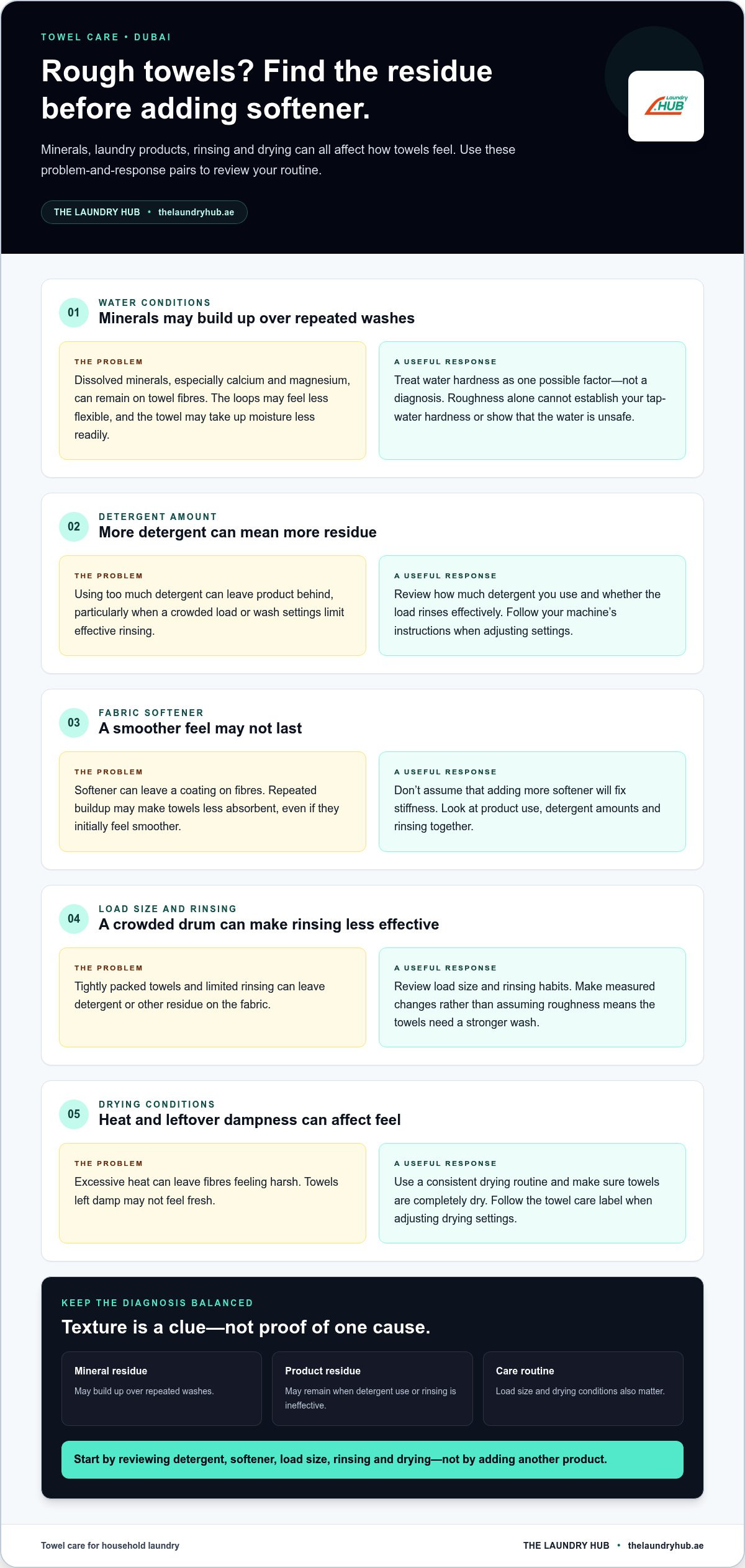
A step-by-step routine to prevent stiff towels at home
A repeatable routine makes it easier to spot which changes help your towels feel better. Keep the process simple: prepare the load, use detergent carefully, rinse according to your machine’s guidance, then dry towels fully. Before adjusting temperature or cycle settings, read the towel care labels and washing-machine instructions. They take priority over general advice.
- Sort the towels. Separate towels from items that need different care, and group colours to reduce the risk of colour transfer. Check labels for special washing or drying instructions before starting.
- Measure detergent. Follow the detergent label and consider the load size and your machine’s instructions. Avoid estimating by eye or adding extra in the hope of improving the wash.
- Load without overcrowding. Put in a manageable amount so the towels have room to move. If the drum is tightly packed, split the load rather than forcing in more items.
- Choose the wash and rinse settings. Use a cycle suitable for the towels, guided by their care labels and the machine manual. If an appropriate additional rinse option is available, follow the instructions for using it.
- Dry thoroughly. Shake each towel out after washing, then use a suitable drying method. Allow good airflow where practical, and make sure towels are fully dry before folding and storing them.
Set up the wash for a cleaner rinse
Start with a load that leaves space for water and movement to reach the textiles. Bulky towels packed tightly together can be harder to rinse effectively. Measure detergent rather than guessing, using the product directions alongside the load size and machine guidance. Select a suitable rinse option if your washer offers one, but don’t override the care label or machine instructions to do so.
Dry towels without making them feel harsher
Once the cycle ends, shake out each towel to separate the pile before drying. Follow care labels when choosing a drying method, and avoid excessive heat or leaving towels to overdry. If air-drying, arrange them with space between items so air can circulate. Towels should be completely dry before you fold and store them, rather than left damp in a pile.
Keep the routine consistent for a few washes and note any change in texture or absorbency. Adjust one habit at a time, so you can tell whether the difference came from the load, detergent, rinse or drying approach. If you’d prefer professional care for household textiles, explore The Laundry Hub’s wash and fold service Dubai guide, or arrange laundry care with The Laundry Hub.
When professional laundry care may help with stiff towels in Dubai
Home adjustments are a sensible first step, but they may not fit every household or resolve every towel-texture concern. If towels remain rough after you’ve measured detergent, avoided crowded loads, followed suitable rinse guidance and dried them carefully, professional laundry care is a practical next option. It can also take routine laundry off your schedule when keeping up with household textiles becomes inconvenient.
Consider what you’ve already changed before deciding what to do next. If only certain towels feel stiff, check their care labels and consider whether their fabric or finish requires particular handling. If residue seems to return across several loads, review detergent use and rinsing as well as your water conditions. Roughness alone can’t confirm the cause, and no single adjustment is right for every textile.
Signs that a different laundry routine may be worth considering
Professional care may suit you if towels still feel rough after a consistent home routine, or if recurring laundry takes more time than you can comfortably spare. Keep specialty and delicate towels guided by their care labels, since their materials may need different handling from everyday cotton towels. Professional laundry is a practical alternative, not a promise that every towel will feel a particular way.
Before handing over household textiles, keep care labels available and separate any items with specific instructions. This helps make their care requirements clear. For towels that can be washed as part of your regular household load, you can continue using the measured, uncluttered routine described earlier while deciding whether professional care better suits your needs.
A convenient laundry option for Dubai households
The Laundry Hub provides laundry and wash-and-fold services for household textiles, with pickup and delivery across the UAE, including Dubai. This can be convenient if you’d rather not manage towel loads at home or want to include them in your regular laundry. It is an option for textile care, not a water-treatment solution, and towel results can depend on their material and condition.
For broader guidance on caring for garments and household textiles, explore the best laundry service UAE guide. You can also explore The Laundry Hub’s laundry services if professional care would make your household routine easier.
To prevent stiff towels from Dubai tap water, start with the home routine and make adjustments you can repeat. If results remain unsatisfactory or laundry becomes a burden, professional laundry and wash-and-fold care offers another practical path. Follow each towel’s care instructions and choose the approach that works best for your household.
Make towel care a routine that works for you
A useful next step is to make towel care easy to repeat. Choose a manageable routine that fits your household, then pay attention to how your towels feel and absorb over time. Small, consistent adjustments are more informative than changing several products or settings at once. That gives you a clearer basis for deciding what to keep, refine or simplify.
Learning how to prevent stiff towels from Dubai tap water doesn’t mean every towel will respond in exactly the same way. Fabric, care instructions and home washing conditions can all affect the result. Give your approach time, and follow each textile’s label when deciding how to care for it. If doing laundry at home no longer suits your schedule, professional care is another option.
For a more convenient way to manage your laundry, explore The Laundry Hub’s laundry services. Arrange professional laundry or wash-and-fold care with The Laundry Hub to make household laundry easier to manage.
Frequently Asked Questions
Can Dubai tap water make towels stiff?
Yes, Dubai tap water can contribute to stiff towels if dissolved minerals remain on the fabric after washing. It isn’t the only possible cause, and water conditions can differ between homes. To prevent stiff towels from Dubai tap water, consider your wash routine as well as the water itself. If the change is sudden or affects several household textiles, review whether detergent, rinse settings or your building’s water storage could also be relevant.
Why do my towels feel rough after washing but still look clean?
A clean appearance doesn’t rule out residue. Minerals, detergent or softener can affect how fibres feel without leaving obvious marks. Check whether the roughness is limited to one towel or appears across a whole load. If only one item has changed, inspect its care label and consider whether its age or fabric finish differs from your other towels. A musty smell or visible staining may point to a separate cleaning issue.
Does fabric softener make towels less absorbent?
It can. Fabric softener may leave a coating on towel fibres, and repeated use can make them take up water less readily. If a towel feels smooth but doesn’t dry your skin as well, try skipping softener for a few washes and compare. Don’t compensate by adding more detergent or using a harsher cycle. Follow the towel label and washer instructions, particularly for towels with special finishes.
How much detergent should I use when washing towels in Dubai?
Use the amount directed on the detergent label for your load, and account for the washer’s guidance and the quantity of towels. There isn’t one universal dose for every product or machine. For example, a small towel load doesn’t automatically need the same amount as a full load. Avoid adding an extra splash because the water seems hard; excess product may be harder to rinse away and can contribute to residue.
Can I use vinegar to soften stiff towels?
Some people use white vinegar in the rinse to help with residue, but it isn’t a guaranteed softening treatment and won’t address every cause of stiffness. Check your washing-machine manual before adding vinegar, since appliance guidance can differ. Never combine vinegar with chlorine bleach or other cleaning products. If you’re unsure whether it’s suitable for your washer or towels, skip it and first try a measured detergent dose and an appropriate rinse.
Should I wash towels in hot or cold water?
Neither temperature is right for every towel. Choose a setting permitted by the care label and your washer’s instructions, and consider the towel’s soil level when selecting a cycle. A higher temperature isn’t automatically a fix for roughness, while a cooler cycle may suit some fabrics and routine loads. If towels have specific hygiene or care requirements, follow the label rather than changing temperature solely to make them feel softer.
When should I consider professional laundry care for stiff towels?
Consider professional care if your towels remain uncomfortable after you’ve tried a consistent home routine, or if laundry is taking more time than you can manage. It can also be a practical option for towels with care instructions that make home washing less straightforward. Keep labels with specialty or delicate textiles so their requirements are clear. Professional handling is an alternative to home laundering, not a guarantee of a particular softness result.
