






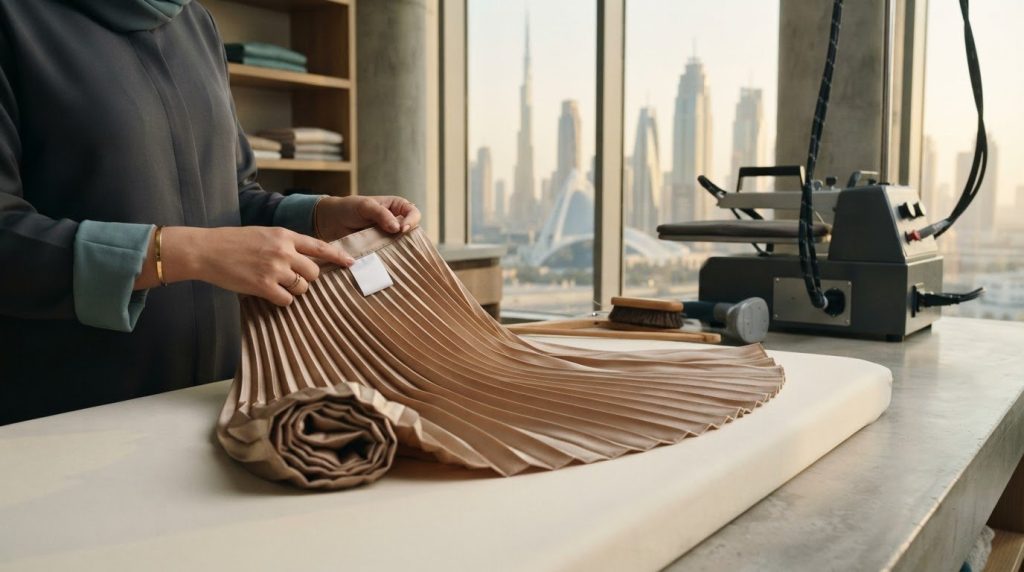
For pleated skirt steam pressing in Dubai, start with the care label. The listed soft, slightly shiny mixed-polyester skirt says not to iron or steam press it. Follow that instruction rather than using heat to restore the pleats. To store this garment, roll it in the direction of the pleats.
It’s understandable to expect steam pressing to smooth creases and sharpen a skirt’s shape, but pleated fabrics need care suited to their material and instructions. This guide explains what pressing can include, how a skirt’s fabric, construction and condition influence the service price, and why the right treatment matters. You’ll also learn how to handle pleats between wears, including the listed skirt’s washing guidance of 30°C or below, so you can make a more informed care decision.
Key Takeaways
- Understand which garment details can influence a skirt-pressing quote, including its fabric, construction and condition.
- Use the care label to guide treatment: the listed soft, slightly shiny mixed-polyester skirt says not to iron or steam press it.
- Learn how careful handling can help reduce the risk of shine, burn marks and unwanted press lines.
- Find out what may help flattened pleats and hemlines regain a neater appearance without assuming every crease can be reset with heat.
- Keep pleats aligned during storage by rolling the skirt in their direction, and follow its washing guidance of 30°C or below.
Dress and skirt pressing prices
The price depends on the work the skirt needs. Request a quote for the specific garment, since fabric, length, pleat structure, condition, and cleaning needs all affect the assessment. A straightforward press and a skirt with visible marks may require different care. Avoid using a general dress category to estimate the cost.
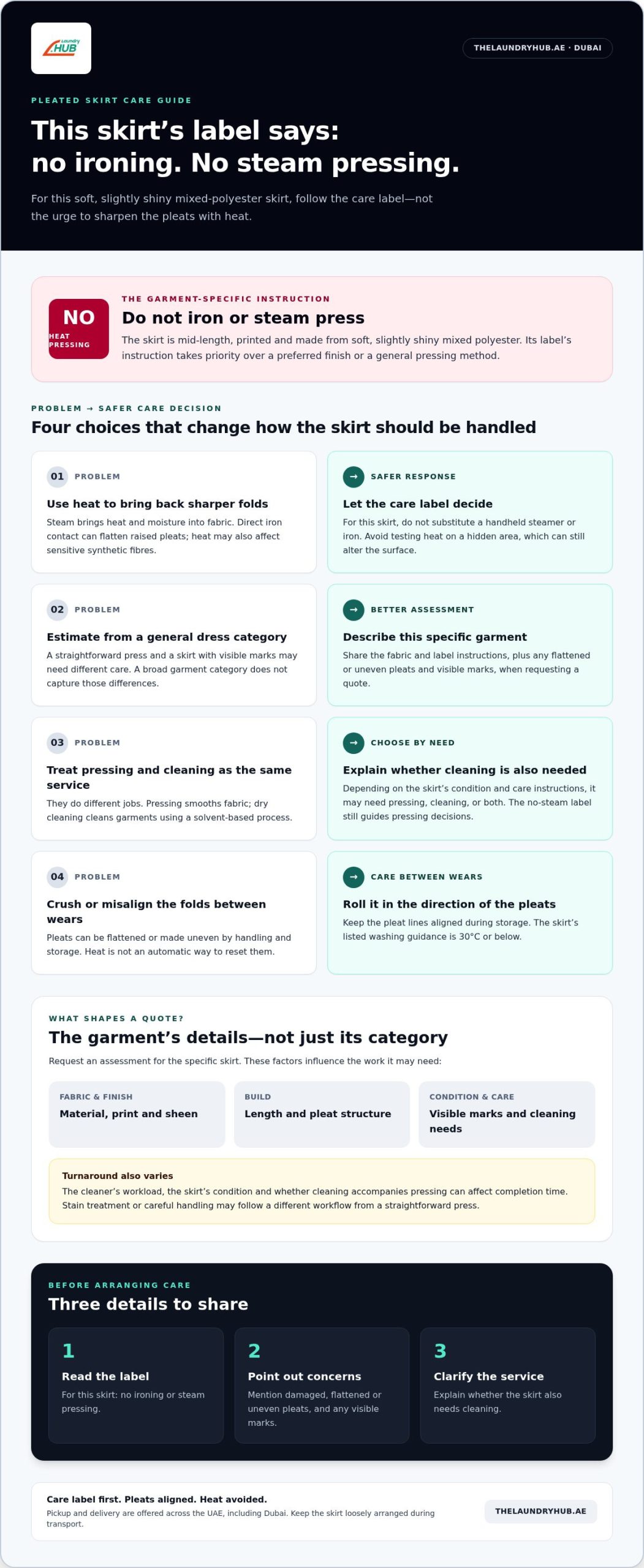
Share the details that affect care: the skirt is mid-length, printed, and made from polyester, with soft, slightly shiny mixed-polyester fabric. Its label says not to iron or steam press it. That instruction guides the suitable treatment as well as the assessment. When requesting a quote, describe the care label, flattened pleats, and any visible marks.
Steam pressing and dry cleaning are different services. Pressing uses heat, moisture, or pressure to smooth fabric, while dry cleaning cleans garments with a solvent-based process. Depending on the skirt’s condition and care instructions, it may need pressing, cleaning, or both.
The Laundry Hub offers pickup and delivery across the UAE, including Dubai. Keep a pleated skirt loosely arranged during transport to help avoid crushing the folds before treatment. Pickup and delivery do not change which pressing method is suitable: the care label should guide that decision.
How long does pleated skirt steam pressing take in Dubai? Turnaround depends on the cleaner’s workload, the skirt’s condition, and whether cleaning accompanies pressing. A garment requiring stain treatment or careful handling may follow a different workflow from a straightforward press. Ask about the expected completion time as part of the quote request.
Before arranging care, follow three practical steps. First, read the garment label. Second, point out damaged, flattened, or uneven pleats. Third, explain whether the skirt also needs cleaning. For the listed skirt, washing guidance says 30°C or below, and storage guidance says to roll it in the direction of its pleats.
These details help identify the right service and the factors that shape its cost. A printed mid-length skirt may need a different assessment from a plain, unpleated garment. The deciding factor is the garment’s care requirement. If the label prohibits steam pressing, follow it rather than choosing a treatment based on price.
High-temperature steam and fabric-sensitive care
Heat is not a universal way to restore pleats. Follow the care label when deciding how to press a garment. The listed skirt is made from soft, slightly shiny mixed polyester, and its instructions say not to iron or steam press it. That warning takes priority over a preference for sharper folds. Heat may affect sensitive synthetic fibres, and direct iron contact can flatten raised pleats. Read the label before choosing a treatment, especially for printed polyester.
Steam brings heat and moisture into fabric, and a high setting can expose delicate fibres to more heat than they tolerate. On the listed skirt, the slight sheen can make changes to the surface more noticeable. Pressing directly against the fabric may flatten areas or leave an uneven appearance. Use the care label as your first guide. If it prohibits steam, do not substitute a handheld steamer or iron.
Before arranging heat-based care, locate the label and read its symbols and instructions. Inspect the waistband, seams, pleat folds, and hem. Note any changes in sheen across the panels or crushed folds. These details help distinguish existing wear from damage caused by unsuitable heat. Keep the skirt away from a hot iron while deciding on its next care step.
- Read the label: Follow its specific ironing and steaming instructions.
- Inspect the fabric: Look for shine, flattened folds, or changed texture.
- Identify the material: Treat mixed polyester according to its garment label.
- Describe the concern: Point out affected pleats or panels before treatment.
For the listed skirt, the instruction is clear: do not iron or steam press it. Wanting to refresh the pleats does not override that direction. Avoid testing heat on a hidden area, as even a small test can alter the surface. Store the skirt carefully between wears, keeping its pleat lines aligned. For another skirt whose label permits steam, let its fabric and construction guide the method.
Careful handling begins before equipment is switched on. Share the label’s instructions and describe the skirt’s fabric, sheen, and visible creases. For garments whose labels permit the method, professional steam pressing can be considered with those care details in view. For the listed mixed-polyester skirt, follow its no-steam instruction instead. That distinction helps protect the fabric while setting realistic expectations for pleat care.
Preventing shine, burn marks, and hard press lines
Shine can appear when pressure flattens fabric against heat. It may show more clearly on a smooth front panel than among the inner folds. Excessive heat or prolonged contact can cause burn marks, while compressing a fold in the wrong place can leave hard press lines. These effects can alter the finish even when the garment remains wearable. Prevent them by matching the method to the fabric and construction.
Before pressing a garment whose label permits it, inspect the skirt under clear light. Look across the waistband, pleat ridges, seams, and hem, and note any glossy patches or sharp creases. This check helps distinguish existing marks from changes during treatment. If the fabric is already shiny at the hip, pressing that area directly may make the contrast more noticeable. Point out existing marks before care begins.
For garments whose labels allow pressing, reduce direct contact and pressure. A clean pressing cloth can act as a barrier between the iron and outer fabric. Use smooth, controlled movements instead of dragging the iron across pleat edges, lifting and repositioning it between sections. Do not leave a hot tool resting in one spot. These steps help limit friction, flattening, and concentrated heat.
- Protect the surface: Place a clean pressing cloth over the fabric.
- Keep folds aligned: Arrange each pleat before treating the surrounding panel.
- Use controlled contact: Lift the iron instead of sliding it over ridges.
- Check as you work: Inspect each section before moving to another.
Pay particular attention to the visible pattern on a printed skirt. Pressing across a raised pleat, for example, can flatten the fold and make the print look uneven. Keep the pleats aligned in their original direction, and do not force a sharp line through a panel. On glossy fabric, compare the treated area with an untouched section. Stop if the surface starts to look different.
Storage can also affect pleats. Hanging a skirt tightly among other clothes may crush its folds, while folding it across the pleats can leave crosswise creases. The listed skirt’s storage guidance is to roll it in the direction of its pleats. This keeps the folds oriented together and avoids adding a crosswise line. Store it in a clean, dry place away from direct heat.
When arranging professional care, describe the specific concern rather than asking only for a sharper finish. Mention shine at the hip, a burn-like mark near the hem, or a hard crease across the front. These details clarify the desired result and help avoid unnecessary pressure on affected areas. The safest finish is not always the sharpest. Respecting the fabric’s texture can help preserve its original appearance.
Restoring flattened pleats and hemlines
To assess flattened pleats, first identify their original direction. Inspect the skirt from waistband to hem, comparing intact folds with compressed sections. Check whether the pleats are stitched, pressed, or formed by the fabric, as this affects how they can be reshaped. An unevenly hanging hem may also make pleats look misaligned, so examine the full length before treating one section.
When choosing a Dubai dry cleaner for a pleated garment, look for a service that handles pleated skirts and follows each item’s care label. The appropriate approach takes the fabric, pleat construction, and existing damage into account before applying heat or pressure.
Can steam pressing damage or flatten pleats, and how can this be prevented? Yes. Heat and pressure can flatten folds, create hard lines, or alter the fabric’s surface. Follow the care label, keep pleat edges aligned, and avoid pressing directly over a fold when the garment’s instructions permit pressing.
For a skirt whose label permits heat, lay it smoothly and align each fold with its original direction. Work in small sections instead of sweeping across several pleats. Keep the hem even and avoid pulling the fabric, which can distort how it hangs. A pressing cloth can reduce direct contact between the iron and fabric. Follow the garment’s instructions throughout.
- Inspect the folds: Compare flattened pleats with intact ones.
- Align the hem: Check that the lower edge hangs evenly.
- Follow the label: Use only a treatment the instructions allow.
- Work carefully: Avoid dragging pressure across pleat edges.
The listed mixed-polyester skirt calls for a different decision: its care instructions say not to iron or steam press it. Do not try to restore its folds with heat, even if they look crushed. The label takes priority over the desired finish. Its storage guidance offers a safer preventive step: roll the skirt in the direction of its pleats.
Changes to the hemline also need careful assessment. A twisted seam, uneven hanging, or a pleat that ends at a different point may have causes beyond pressing. Note the location and appearance before arranging care. Pressing can smooth fabrics when their labels allow it, but it cannot change a garment’s construction. Avoid pulling or pinning the hem into a new position.
When arranging garment care, share the skirt’s fabric, care-label instructions, and flattened areas. For example, describe whether the folds are compressed throughout or only near the hem. This helps distinguish a surface crease from a wider change in shape. For the listed skirt, avoid heat and maintain the pleat direction during storage.
Special pressing instructions
Start with the care label, not the steamer. The listed soft, slightly shiny mixed-polyester skirt says not to iron or steam press it. Do not steam it at home, even through a cloth. For another pleated skirt, use heat only if its own label permits it. Fabric, pleat construction, and printed details all matter.
How can I steam press a pleated skirt at home without ruining the pleats? First, read its care label. If steam pressing is prohibited, do not use a steamer or iron. If the label permits steam, hang the skirt, align its folds, and keep the steamer moving without pressing the pleats flat.
For a skirt whose label permits pressing, prepare it before switching on any equipment. Choose a clear space where the hem can hang freely. Check for stains, loose threads, or existing shiny patches, and note how the pleats fall from waistband to hem. Do not pull a fold into a new shape. Keep the skirt away from direct contact with a hot iron.
- Read the instructions. Identify any limits on ironing or steaming.
- Arrange the skirt. Hang it and align each pleat by hand.
- Test the method. Follow the appliance instructions and garment label.
- Move steadily. Direct steam lightly, without flattening the folds.
- Let it settle. Keep the garment hanging until its fabric feels dry.
Keep the steamer nozzle from touching the fabric. Work along the pleats rather than across them, pausing between sections to check their shape. If the fabric’s sheen changes or a crease sharpens, stop. Do not apply more heat to correct an unexpected mark, as another pass can increase heat exposure or pressure.
The listed skirt’s washing guidance is 30°C or below. That washing limit doesn’t mean steaming is safe. Its separate care instruction prohibits ironing and steam pressing. Keep those instructions distinct. If the skirt needs refreshing, avoid substituting a home steam treatment for the prohibited method. Preserve its shape between wears by rolling it in the pleats’ direction.
Printed fabric needs a careful visual check, too. The listed skirt has a broken-flowers pattern printed on polyester. Inspect the pattern before and after any care permitted by the label, comparing adjacent pleats for changes in alignment or appearance. If the label rules out steam, leave the steamer aside. Following the garment’s specific instructions is the safest home-care step.
The Laundry Hub: Laundry and Dry Cleaning
The Laundry Hub offers Steam Pressing for garments that need careful presentation. If a pleated skirt’s label allows pressing, share its instructions and point out flattened folds or uneven areas. For the listed soft, slightly shiny mixed-polyester skirt, the label says not to iron or steam press it, so avoid heat-based treatment. Laundry and Dry Cleaning is also available when the garment needs cleaning as well as attention to its appearance. Choose based on the skirt’s care instructions and condition.
For other household and wardrobe needs, The Laundry Hub also provides Shoe & Bag Care and curtain and carpet cleaning. To discuss garment care, contact The Laundry Hub.
Choose the Next Step with Confidence
Let the garment’s care instructions guide your next decision. If you are unsure whether heat is suitable for a particular skirt, avoid home treatment that could change its finish. For pleated skirt steam pressing in Dubai, share the garment’s care needs and the result you want when arranging service. Request a quote based on the skirt’s fabric, construction, condition, and required care.
The Laundry Hub provides Steam Pressing and Laundry and Dry Cleaning. Shoe & Bag Care, curtain cleaning, and carpet cleaning are also available for other wardrobe and household needs. Choose the service that matches the item, and keep its care instructions close at hand.
When you’re ready to discuss care for your skirt, contact The Laundry Hub about pressing. A thoughtful next step can help you care for your garment with greater confidence.
Frequently Asked Questions
Where can I get a pleated skirt steam pressed in Dubai?
The Laundry Hub provides Steam Pressing in Dubai. For pleated skirt steam pressing in Dubai, share the garment’s care instructions and describe the result you want. This helps distinguish a skirt whose label permits steam from one that prohibits it. The Laundry Hub also provides Laundry and Dry Cleaning when the garment needs cleaning alongside pressing. Follow the skirt’s care label when choosing the appropriate service.
How much does pleated skirt steam pressing cost in Dubai?
The price depends on the garment and is provided after a quote request. Cost factors include fabric, skirt length, pleat construction, condition, and whether cleaning is also needed. A skirt with delicate folds or visible marks, for example, may need different care from one requiring a straightforward press. Share the garment’s details when requesting a quote so the price reflects the work required.
Is steam pressing safe for different pleated skirt fabrics?
Steam pressing is suitable only when the garment’s care instructions allow it. Fabric type and finish affect how heat and moisture may change a skirt. The listed soft, slightly shiny mixed-polyester skirt specifically says not to iron or steam press it. Do not assume that another polyester, silk, or blended skirt has the same instructions. Check its own label before choosing heat-based treatment.
How should a pleated skirt be prepared for professional steam pressing?
Before sending a skirt for care, remove items from its pockets and any detachable accessories. Keep the care label readable, and point out marks, loose threads, or areas needing particular attention. Avoid applying home stain treatments first, as they can change the fabric’s appearance. If the skirt has a matching belt or removable decoration, keep it with the garment and mention it when arranging care.
